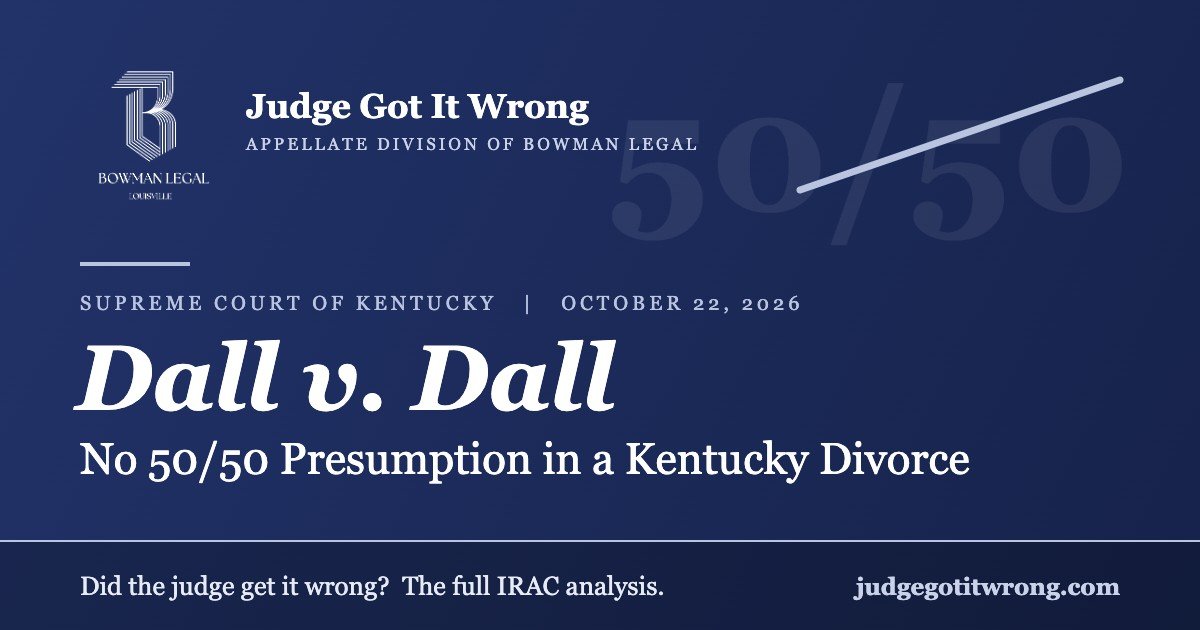
Dall v. Dall: No 50/50 Presumption in a Kentucky Divorce
Key Takeaways: Dall v. Dall (Ky. Oct. 22, 2026)
- On October 22, 2026, the Supreme Court of Kentucky rendered Dall v. Dall, No. 2025-SC-0077-DG, a published opinion reversing the Court of Appeals and remanding a Jefferson Family Court divorce judgment for further proceedings.
- KRS 403.190 contains no presumption that marital property will be divided equally. A family court that reads legislative intent into the statute to presume a 50/50 split commits reversible error when that presumption drives the result.
- Earnings and asset growth after a physical separation remain marital property until the decree, because only a decree of legal separation stops the accrual of marital property.
- A spouse’s contributions, or lack of them, during the separation are something the court must consider, but no single factor carries decisive weight.
- Before awarding spousal maintenance, a court must first find under KRS 403.200(1) that the requesting spouse lacks sufficient property, including the marital property awarded to him, and cannot support himself through appropriate employment.
Did the Judge Get It Wrong in Dall v. Dall?
According to five Justices of the Supreme Court of Kentucky, yes. The family court divided a marital estate worth roughly $19 million straight down the middle after concluding that the General Assembly intended equal division for spouses who “operate as a functioning, commingled unit over time.” The Supreme Court held that Kentucky law contains no such presumption, that the error was not harmless, and that the property division and the $15,000 per month maintenance award both must be redone.
Two Justices disagreed, and their dissent is worth reading. It argues the family court’s language was mere surplusage, that an equal division was well within the court’s discretion on this record, and that sending a thirty eight year marriage back for another round invites the parties to keep spending money on lawyers. We walk through both sides below using the traditional Issue, Rule, Analysis, and Conclusion (IRAC) framework.
A Note Before We Begin: Bowman Legal Was Not Involved in This Case
Judge Got It Wrong is the appellate commentary site of Bowman Legal, a Louisville family law and appellate firm. Neither Bowman Legal nor Jason A. Bowman represented any party in Dall v. Dall, at any stage. This analysis is based solely on the Supreme Court’s published opinion. We have not reviewed the trial record, and nothing here is intended to characterize the parties, their counsel, or the trial judge beyond what the opinion itself says.
Dall v. Dall at a Glance
| Case | Marcia Ann Dall v. Roger Wayne Dall, et al. |
| Court | Supreme Court of Kentucky, on discretionary review from the Court of Appeals |
| Docket | 2025-SC-0077-DG (Court of Appeals No. 2024-CA-0003; Jefferson Circuit Court No. 20-CI-500458) |
| Rendered | October 22, 2026 |
| Status | To Be Published |
| Author | Justice Goodwine, joined by Chief Justice Lambert and Justices Bisig, Conley, and Nickell |
| Dissent | Justice Thompson, joined by Justice Keller |
| Disposition | Court of Appeals reversed; remanded to Jefferson Family Court |
| Statutes | KRS 403.190 (division of property); KRS 403.200 (maintenance) |
What Happened in the Dall Divorce?
Marcia and Roger Dall married in December 1984. Both started out in comparable jobs, she as an accountant and he as a quality control chemist. Over the next two decades Marcia’s career took off, and the family relocated repeatedly for her promotions: Connecticut, Illinois, North Carolina, Connecticut again, Pennsylvania, and finally Louisville in 2015, when she became Chief Financial Officer and Executive Vice President of Churchill Downs Incorporated. Roger resigned from his own job with each move. In 2002, after the move to North Carolina, he left a position paying about $120,000 a year and never returned to work outside the home, becoming a stay at home father.
The children were emancipated by 2012. Roger moved out in February 2020, and Marcia filed for divorce in Jefferson Family Court. At separation the marital estate was worth about $11.9 million. By the November 2022 trial, driven largely by Marcia’s compensation, it had grown to about $19.2 million.
Marcia asked for a 60/40 division in her favor and argued that the growth after separation was hers alone. Roger asked for an equal division, an equalization payment, attorney’s fees, and $44,000 per month in maintenance. In its May 25, 2023 judgment, the family court:
- classified the post separation growth as marital property;
- divided the entire marital estate equally;
- awarded Roger $15,000 per month in maintenance until Marcia reaches 65 or retires, whichever is later; and
- awarded Roger $110,630.99 in attorney’s fees and costs.
The Court of Appeals affirmed the equal division and the maintenance award, while reversing on three narrower points (classification of certain nonvested performance stock units, a $133,035.05 offset for money advanced to Roger, and duplicative fee entries). Only Marcia sought further review. Because Roger did not, the Court of Appeals’ remand instructions on those three points stand to the extent consistent with the Supreme Court’s opinion.
Issue 1: Does Kentucky Presume a 50/50 Split of Marital Property?
The Issue
Did the family court err by interpreting KRS 403.190 to presume an equal division of marital property when spouses function as a “commingled unit,” and if so, was the error reversible?
The Rule
KRS 403.190(1) requires a court to divide marital property “in just proportions” after considering all relevant factors, including (a) each spouse’s contribution to acquiring the property, including contribution as a homemaker; (b) the value of property set apart to each spouse; (c) the duration of the marriage; and (d) each spouse’s economic circumstances when the division takes effect. Merely citing the statute is not enough; the court must show it actually weighed the factors. Thielmeier v. Thielmeier, 664 S.W.3d 563, 574 (Ky. 2022).
The statute is unambiguous, so courts apply its plain language without construction. Stephenson v. Woodward, 182 S.W.3d 162, 170 (Ky. 2005). Kentucky has long held there is no presumption of an equal division without regard to the evidence. Gaskill v. Robbins, 282 S.W.3d 306, 316 (Ky. 2009); Herron v. Herron, 573 S.W.2d 342, 344 (Ky. 1978). Whether a trial court applied the correct statutory framework is reviewed de novo. Holeman v. Holeman, 84 S.W.3d 903, 905 (Ky. 2002). The division itself is reviewed for abuse of discretion.
The Analysis
The family court stated it “must consider not only the language contained in the statute but also the intent of the legislature,” and concluded that in a long, commingled marriage the legislative intent “is to separate the parties and their accumulated assets/debts equally.” The Supreme Court held that this was error under the plain language of KRS 403.190 and Herron, which forbids courts from reading presumptions into the statute.
The harder question was whether the error mattered. Roger relied on Gaskill, where the Court affirmed an equal division even though one spouse earned ninety percent of the income. The majority distinguished Gaskill on a key point: the trial court there expressly acknowledged that just proportions does not require equal division and that presuming equal division is improper. The Dall family court said nothing of the kind. Instead, it found that Roger’s decision not to work after the children left home did not “affect[] his right to an equal division of the marital estate.” The majority read the phrase “right to an equal division” as proof that the presumption was operating, and concluded that “the family court’s faulty presumption served as the decisional basis for its ultimate decision to equally divide the marital estate.”
The Conclusion
Reversed and remanded. The family court must redivide the marital estate under the plain language of KRS 403.190(1), without indulging in statutory interpretation. Notably, the opinion does not hold that a 50/50 division is wrong for this couple. It holds that equality cannot be the starting assumption; any division, equal or not, must rest on the statutory factors and the evidence.
Issue 2: Is Money Earned After Separation Still Marital Property in Kentucky?
The Issue
Was the more than $7 million in growth between separation and judgment, attributable to Marcia’s compensation, properly treated as marital property, and was the family court required to find that Roger made a continuing contribution during the separation before sharing it with him?
The Rule
Under KRS 403.190(2), property acquired after the marriage is marital unless an exception applies, including property acquired after a decree of legal separation. Physical separation is not legal separation. “Separation” means a legal separation granted by decree under KRS 403.140(2). Stallings v. Stallings, 606 S.W.2d 163, 164 (Ky. 1980). Marital property acquired between separation and decree is divided like any other marital property, using the KRS 403.190(1) factors. Id.; Thielmeier, 664 S.W.3d at 573.
The Analysis
The parties separated physically in February 2020, but no decree of legal separation was ever entered, and Marcia identified no other statutory exception. The classification as marital was therefore correct. Because the Court had already ordered a new division, Marcia’s challenge to how the post separation property was divided was technically moot, but the Court addressed it to guide the family court on remand.
Marcia argued that Shively v. Shively, 233 S.W.3d 738 (Ky. App. 2007), and Thielmeier require a continuing contribution by the nonearning spouse before he can share in post separation earnings. The Court disagreed with that reading. Shively involved a ten year marriage in which both spouses had financially fruitful careers, which is a very different picture from a thirty eight year marriage in which one spouse gave up his career two decades earlier. Thielmeier, the Court explained, turned on the trial court’s internally inconsistent findings, not on any rule that continuing contribution is dispositive. The Court also declined to follow a Connecticut decision, Wendt v. Wendt, 757 A.2d 1225 (Conn. App. 2000), on the ground that Kentucky case law is already clear.
The Conclusion
A trial court must consider whether one spouse helped the other acquire marital property, including during the separation, but the law does not give that factor, or any factor, decisive weight. On remand, the family court may weigh Roger’s tangible and intangible contributions throughout the marriage, some of which may have helped Marcia earn what she earned after the parties separated.
Issue 3: When Can a Kentucky Court Award Spousal Maintenance?
The Issue
Did the family court make the threshold findings KRS 403.200(1) requires before awarding maintenance?
The Rule
A court may award maintenance only if it finds the requesting spouse (a) lacks sufficient property, including marital property apportioned to him, to provide for his reasonable needs, and (b) is unable to support himself through appropriate employment, or is the custodian of a child whose circumstances make outside employment inappropriate. KRS 403.200(1). Maintenance awards are reviewed for abuse of discretion. Powell v. Powell, 107 S.W.3d 222, 224 (Ky. 2003).
The Analysis
The family court focused on Roger’s age and twenty years out of the workforce, but it did not account for the substantial property it had just awarded him. It reasoned instead that the law does not require a spouse to rely solely on assets from the marital division to meet his needs. The Supreme Court emphasized the statutory text: the court may award maintenance only if it finds the spouse lacks sufficient property, including marital property apportioned to him.
The Conclusion
Because the property division must be redone, maintenance must be reassessed as well. On remand, the family court must make findings on both prongs, including whether Roger can provide for himself through appropriate employment and whether his share of the marital estate can meet his reasonable needs.
The Dissent: Was This Harmless Error?
Justice Thompson, joined by Justice Keller, would have affirmed. The dissent makes three points that deserve serious attention.
- The order on the post judgment motions told a different story. In ruling on the CR 59.05 motions, the family court repeatedly stated that it was charged with an equitable, not equal, division and that it was confident its disposition was equitable. To the dissent, that refutes any suggestion the court felt bound to split everything evenly.
- The result was supportable on the evidence. An equal division can be a just division (Gaskill), and the findings about Roger’s career sacrifice, the relocations, the child rearing, and the upkeep of the home gave ample support for it. At most, the legislative intent discussion was harmless.
- The maintenance rationale was obvious. Much of the estate sat in Marcia’s retirement accounts, which could not be reached without tax penalties, and Marcia was awarded the marital home. Tying maintenance to her retirement made practical sense.
The dissent closed with a concern familiar to every family law practitioner: a remand in a case like this one can drag on and consume more of the estate in attorney’s fees. It urged the family court to resolve the case expeditiously and suggested an amended judgment could be entered on the existing record.
Our Take: Did the Supreme Court Get It Right?
On the law, the majority stands on firm ground. Herron and Gaskill have said for decades that KRS 403.190 does not presume equality, and a judgment that speaks of a spouse’s “right to an equal division” is difficult to square with that rule. Appellate courts review what the trial court actually wrote, and when the written reasoning reveals the wrong legal framework, a reviewing court cannot easily assume the right one was applied silently.
The dissent’s strongest point is the CR 59.05 order. If a trial court later explains, in plain terms, that it understood its job was an equitable rather than equal division, there is a fair argument that the original language was loose phrasing rather than a decisional rule. Reasonable appellate judges can, and here did, disagree about how much weight a later order should carry in reading an earlier judgment.
What Dall does not do is just as important as what it does. It does not hold that a long marriage with a homemaker spouse must produce an unequal division. It does not hold that post separation earnings belong to the earning spouse. It does not cap maintenance. It holds that the family court must reach its result through the statutory factors and make the findings the statutes require. In short, the judge got the framework wrong, and in Kentucky the framework is what an appellate court reviews.
What Happens Next on Remand?
The case returns to Jefferson Family Court. The court must redivide the marital estate under KRS 403.190(1) without any presumption of equality, reassess maintenance with findings under both prongs of KRS 403.200(1), and carry out the Court of Appeals’ unchallenged instructions on the nonvested performance stock units, the $133,035.05 offset, and the duplicative attorney’s fee entries, to the extent consistent with the Supreme Court’s opinion. The opinion does not dictate any particular percentage or maintenance figure.
Frequently Asked Questions About Dall v. Dall
Does Kentucky divide marital property 50/50 in a divorce?
Not automatically. KRS 403.190(1) requires division in “just proportions” after weighing the statutory factors. Dall v. Dall (Ky. 2026) reaffirms that there is no presumption of an equal split, although an equal division can still be a just division when the evidence supports it.
Is income earned after separation marital property in Kentucky?
Yes, unless a statutory exception applies. Under Stallings v. Stallings and Dall v. Dall, property acquired after a physical separation but before the decree remains marital property, because only a decree of legal separation stops the accrual of marital property.
Does a spouse have to contribute during the separation to share in post separation property?
No single factor controls. The Supreme Court held in Dall that a court must consider each spouse’s contributions, including any help during the separation, but no precedent gives that factor decisive weight.
What must a Kentucky court find before awarding spousal maintenance?
Under KRS 403.200(1), the court must find that the spouse seeking maintenance lacks sufficient property, including the marital property awarded to him or her, to meet reasonable needs, and is unable to self support through appropriate employment or is the custodian of a child whose circumstances make outside employment inappropriate.
Who decided Dall v. Dall, and was it unanimous?
Justice Goodwine wrote for a five Justice majority. Justice Thompson dissented, joined by Justice Keller, and would have affirmed the family court in full.
Was Bowman Legal involved in Dall v. Dall?
No. Bowman Legal and Jason A. Bowman did not represent any party in this case. This analysis is based solely on the Supreme Court’s published opinion.
For a plain English look at what Dall means for Kentucky families dividing a marital estate, see Bowman Legal’s KY Legal Update, Kentucky Divorce Is Not 50/50: What Dall v. Dall Means for Property Division.
Kentucky Divorce Representation at Bowman Legal
Dall is a reminder that high stakes property division and maintenance disputes are won or lost on the findings, and that the record built in the trial court is the record every appellate court will read. Bowman Legal’s divorce practice handles contested divorces in Jefferson Family Court and across Kentucky, including complex marital estates, executive compensation, retirement and stock accounts, post separation property, and spousal maintenance. Learn more about Bowman Legal’s Kentucky divorce practice, or about the firm’s family law appeals practice.
To discuss a divorce or family law appeal, contact Bowman Legal at (502) 861-7414 or through the firm’s contact page. Bowman Legal, 6100 Dutchmans Lane, Suite 1100, Louisville, Kentucky 40205.