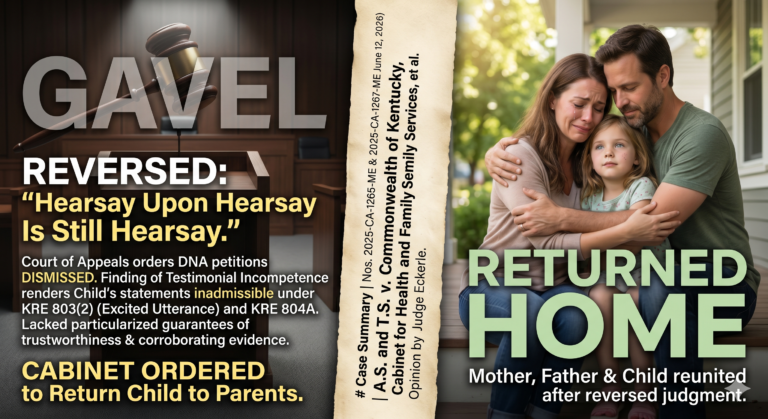
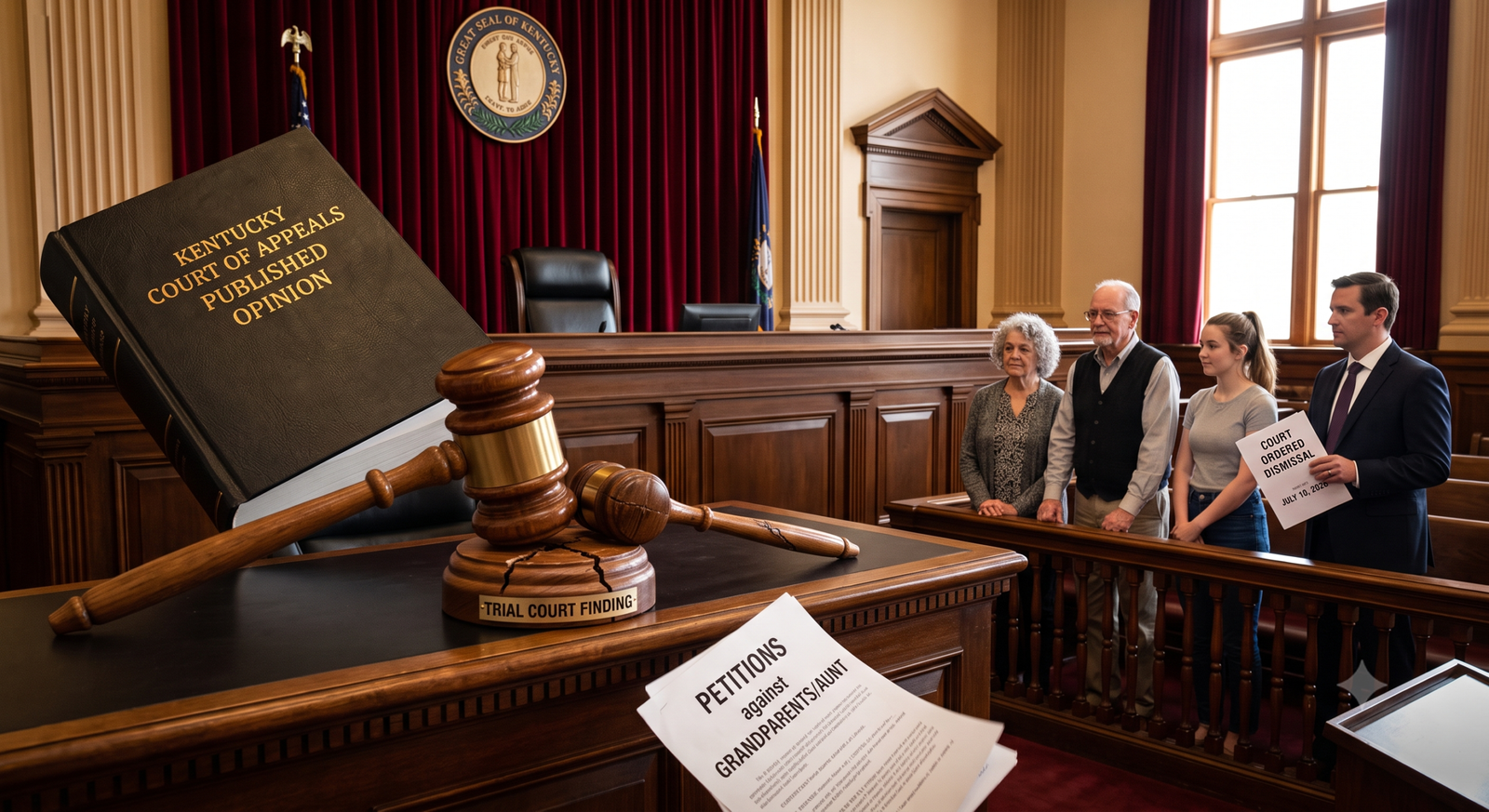
Guilt by Address: Kentucky Court of Appeals Reverses DNA Findings Against Grandparents and Aunt
J.D., A.D., and E.D. v. Commonwealth of Kentucky, Cabinet for Health and Family Services, No. 2025-CA-1609-ME (Ky. App. July 10, 2026) (To Be Published)
On July 10, 2026, the Kentucky Court of Appeals issued a published opinion reversing a Henderson Family Court adjudication that found a grandmother, a grandfather, and an aunt had abused a five month old infant. The family court’s own investigator admitted she could not identify who caused the child’s injuries, when, or in which household. The family court adjudicated all three relatives anyway, along with the child’s parents and her mother’s boyfriend, reasoning that each of them had access to the household at some point during a two month window. The Court of Appeals held that access is not evidence, and reversed.
Bowman Legal represented the three relatives on this appeal. This is our account of how the family court’s finding fell apart, and what the published opinion now means for every extended family caught up in a Kentucky dependency, neglect, and abuse case.
Key Takeaways
- The Kentucky Court of Appeals reversed abuse adjudications against a grandmother, grandfather, and aunt because the Cabinet could not prove that any of them inflicted the child’s injuries or knew, or had reason to know, that someone else was.
- The family court adjudicated all three based only on the fact that each had, at some point, been present in the household, a standard the Court of Appeals held falls far short of the burden of proof.
- None of the three appellants was the child’s parent, guardian, or legal custodian. Under KRS 600.020(47), a non-parent can be adjudicated only if that person assumed the role and responsibility of a parent, and the Court held that occasional babysitting does not meet that bar.
- The opinion is published, which makes it binding precedent in every Kentucky family court, not just persuasive commentary.
- The Cabinet has until July 30, 2026 to ask the Court of Appeals to reconsider, and until August 9, 2026 to ask the Kentucky Supreme Court to take the case. Absent either filing, the ruling becomes final and permanent on August 10, 2026.
The Background: An Injury Nobody Could Explain
The child was born in September 2024 to unmarried parents who shared an alternating custody schedule beginning in January 2025, moving every two to three days between her father’s household, which included his parents and his 18 year old sister, and her mother’s household, which included her mother’s boyfriend.
In March 2025, when the child was approximately five months old, her mother took her to the hospital for what turned out to be a birthmark. Imaging performed during that visit revealed something else entirely: a healing fracture of the child’s posterior seventh rib. A follow up appointment in April 2025 turned up a second, newer rib fracture and bruising on the child’s jawline. Dr. Melissa Currie of Norton Children’s Hospital’s pediatric protection team testified that the injuries were the product of non-accidental trauma, and a second opinion from a Vanderbilt provider confirmed it.
What nobody could do, not Dr. Currie, and not the Cabinet’s own investigator after a full investigation, was say who caused the injuries, exactly when, or in which house. Rather than confine the case to the two parents, the Cabinet filed dependency, neglect, and abuse petitions against six adults: both parents, the mother’s boyfriend, and three members of the father’s household, a grandmother, a grandfather, and an aunt.
At the adjudication hearing, the Cabinet’s investigator testified that she named the three relatives because “all of these parties resided in the home when the child was there for each respective parent’s parenting time, so therefore, they had equal access and equal opportunity to be around the child.” She agreed the aunt’s entire contact with the child was a single occasion in January 2025, babysitting for no more than thirty minutes before calling the grandmother for help. She agreed the grandfather, who traveled constantly for work, rarely spent time with the child at all. Counsel for the Cabinet acknowledged at the close of the evidence that it was “impossible to identify the perpetrator.”
The family court itself said, on the record, “I don’t know who did it. I’m not going to lay the blame at any person’s foot.” It adjudicated all six respondents anyway, reasoning that each had “failed to protect the child or provide an adequate explanation for the injuries.”
Where the Family Court Got It Wrong
1. Access is not proof of knowledge
Kentucky law does not require the Cabinet to identify a specific perpetrator before a family court can find that abuse occurred, so long as the finding runs against “the parents” as a class. Commonwealth, Cabinet for Health & Family Services ex rel. M.H. v. R.H., 199 S.W.3d 201, 204 (Ky. App. 2006). But the Cabinet did not stop at the parents here. Once it reached beyond them to adjudicate three additional relatives, the Court of Appeals held, it had to prove, person by person, that each one either inflicted the injury or knew, or had reason to know, that someone else was. The record contained no such proof as to any of the three appellants, only a finding that each had, at some point, been in the house.
2. The family court shifted the burden of proof
The family court penalized the grandparents and the aunt for failing to provide a credible explanation for the child’s injuries, treating their lack of any explanation, injuries none of them had ever witnessed, as evidence of guilt. The Court of Appeals rejected that reasoning outright:
“None of the Appellants expressed any such knowledge or observation and there was no evidence refuting their denials.” The court’s finding that “none of these Appellants could provide an explanation for the injuries” is simply not sufficient to sustain a finding that each of them abused the child.
Requiring people who specifically denied any knowledge to explain injuries that neither the Cabinet’s own trained investigator nor its own medical expert could explain either is impermissible burden shifting. S.H. v. Cabinet for Health & Fam. Servs., 717 S.W.3d 749 (Ky. App. 2025).
3. Occasional caregivers are not “persons exercising custodial control or supervision”
None of the three appellants was the child’s parent, guardian, or legal custodian. Under KRS 600.020(47), a non-parent can be adjudicated in a dependency, neglect, and abuse case only if that person “assumed the role and responsibility of a parent or guardian for the child.” The Court of Appeals compared the appellants’ situation to Department for Community Based Services, Cabinet for Health and Family Services v. Baker, 613 S.W.3d 1 (Ky. 2020), and Cabinet for Health & Fam. Servs. v. Baker, 645 S.W.3d 411 (Ky. 2022), both of which held that someone who is, in substance, just a babysitter does not have the kind of custodial control the statute requires.
“The evidence presented at the hearing did not support a finding that Appellants ‘assumed the role and responsibility of a parent or guardian.'”
A grandmother who occasionally watched the child while the father worked, a grandfather who was rarely even present, and an aunt whose only solo attempt lasted thirty minutes are not meaningfully different from the afterschool worker in Baker. As the Court put it, the Cabinet’s duty to investigate “does not open the door to hold any person who has ever resided with or babysat a child” as a target of a dependency, neglect, and abuse proceeding.
4. A risk of harm cannot rest on stacked assumptions
The Court of Appeals also reaffirmed that a risk of harm theory cannot rest on speculation:
“A risk of harm cannot be established through inferences upon inferences, as that is nothing but speculation.” C.L. v. Cabinet for Health & Fam. Servs., 653 S.W.3d 599, 609 (Ky. App. 2022).
The family court had authority to protect the child by imposing restrictions directly on the two parents, and it had already done so, without adjudicating three relatives whose entire connection to the case was living in, or occasionally visiting, the household.
Why This Published Opinion Matters
Most Kentucky Court of Appeals opinions are not designated for publication, which means they carry no binding weight on future cases. This one is different. The panel marked the opinion to be published, which means every family court judge in Kentucky, and every future Court of Appeals panel, is now bound to follow its reasoning. A ruling that started as one family’s appeal is now a permanent part of Kentucky family law, protecting every grandparent, aunt, uncle, or occasional caregiver who might otherwise be swept into a dependency, neglect, and abuse petition on nothing more than having lived in, or visited, the house.
The opinion is not final yet. The Cabinet has 20 days from July 10, 2026 to ask the Court of Appeals to reconsider through a petition for rehearing, and 30 days to ask the Kentucky Supreme Court to take the case through a motion for discretionary review. That second option is discretionary, meaning the Supreme Court has to agree to hear it at all before either side files a brief on the merits, and it denies far more of these motions than it grants. Absent either filing, the opinion becomes final and permanently binding on August 10, 2026.
Frequently Asked Questions
Can a Kentucky family court find someone abused a child without identifying who actually caused the injury?
Kentucky case law does not require the Cabinet to identify a specific perpetrator to establish that abuse occurred, so long as the finding runs against the parents as a class. But once the Cabinet reaches beyond the parents to adjudicate additional individuals, this opinion holds that it must prove, person by person, that each specific individual inflicted the injury or knew, or had reason to know, that someone else was.
Can grandparents or other relatives be adjudicated for abuse just for living in the household?
Not under this published opinion. Mere access to a child during the period in question is not substantial evidence of abuse or neglect. A non-parent respondent must have assumed the role and responsibility of a parent or guardian, qualifying as a person exercising custodial control or supervision under KRS 600.020(47), before that person can be adjudicated at all.
What if the judge says there is no way to know who is responsible?
That is exactly what happened here. The family court judge said on the record that he did not know who caused the injuries and was not going to lay the blame at any one person’s foot, then adjudicated six people anyway. The Court of Appeals held that acknowledging the perpetrator is unknown does not excuse the Cabinet from proving an individualized case against each specific person it adjudicates.
Does winning this kind of appeal remove someone from Kentucky’s Central Registry?
A sustained adjudication of abuse can lead to placement on Kentucky’s Central Registry under 922 KAR 1:470 for at least seven years, which can affect the ability to foster, adopt, coach, or work with children or seniors. A reversal that dismisses the petition, as happened here, avoids that exposure entirely.
Can the Cabinet still appeal this decision?
Yes. The Cabinet may file a petition for rehearing with the Court of Appeals within 20 days of the July 10, 2026 rendition date, or a motion for discretionary review with the Kentucky Supreme Court within 30 days. A motion for discretionary review is not an appeal as of right, the Supreme Court must first agree to accept the case before either side files a merits brief.
The Judge Got It Wrong. Yours Might Have Too.
If a Kentucky family court has adjudicated you, or a family member, for abuse or neglect based on nothing more than living in a household, you may have grounds for appeal. Bowman Legal handles family court appeals across Kentucky, including DNA adjudications, custody rulings, and evidentiary errors like the ones in this case. Appellate deadlines run quickly, often within thirty days of the order, so do not wait.
Call (502) 861-7414 or email appeals@bowmanlegalgroup.com today for a consultation.
Jason A. Bowman
Bowman Legal
6100 Dutchmans Lane, Suite 1100
Louisville, KY 40205
(502) 861-7414
appeals@bowmanlegalgroup.com
Disclaimer: This article is attorney advertising and is provided for informational purposes only. It is not legal advice and does not create an attorney client relationship. Bowman Legal represented the Appellants in the case discussed above. Past results do not guarantee a similar outcome in any future matter. Case details are taken from the published opinion of the Kentucky Court of Appeals, which is subject to further review until final.