Hearsay Upon Hearsay: Kentucky Court Reverses DNA Abuse Ruling
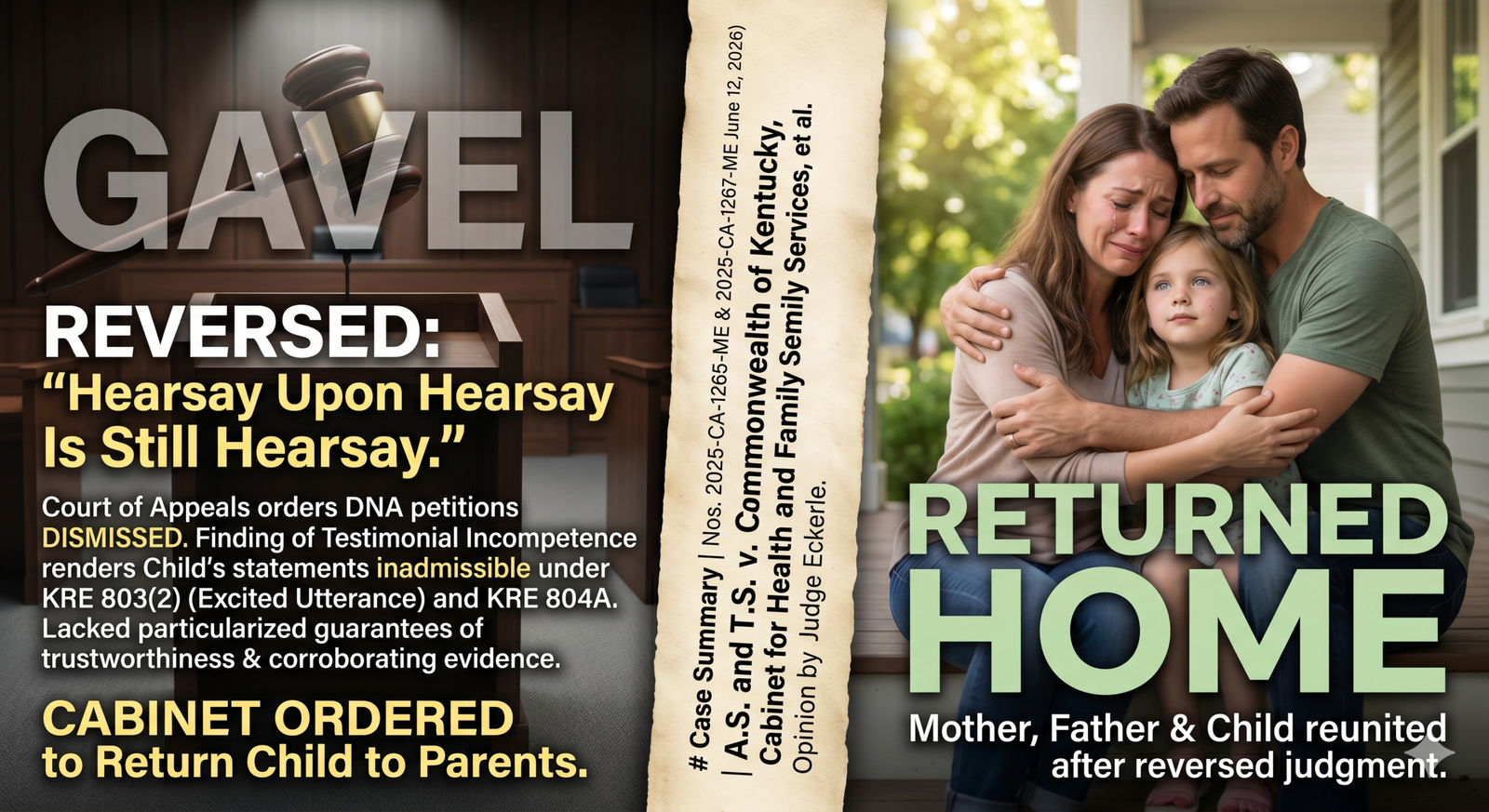
A.S. and T.S. v. Cabinet for Health and Family Services, Nos. 2025-CA-1265-ME and 2025-CA-1267-ME (Ky. App. June 12, 2026) (To Be Published)
On June 12, 2026, the Kentucky Court of Appeals issued a published opinion reversing a Henry Family Court adjudication that found two parents had sexually abused their child. The appellate court did not merely disagree with the family court’s weighing of the evidence. It held that there was no admissible evidence at all. Every word of proof supporting the removal of a child from her parents was unsworn, out of court hearsay, retold by third parties, from a child the trial judge herself had ruled incompetent to testify. The Court of Appeals reversed and remanded with instructions to dismiss the petitions and return the child to her parents.
This is exactly the kind of case this site exists to cover. A family was separated for over a year based on evidence that should never have been admitted. Here is what happened, what the law actually requires, and what it means for Kentucky parents facing a Dependency, Neglect, and Abuse case.
Key Takeaways
- The Kentucky Court of Appeals reversed DNA adjudication and disposition orders against both parents because the only evidence of abuse was inadmissible child hearsay.
- When a trial court finds a child incompetent to testify because she cannot distinguish truth from falsehood, that same incompetence undermines the reliability of her out of court statements under B.B. v. Commonwealth, 226 S.W.3d 47 (Ky. 2007).
- KRE 804A requires both particularized guarantees of trustworthiness and, when the child does not testify, independent corroborative evidence. A child’s statement to one adult cannot corroborate the same child’s statement to another adult.
- A forensic interviewer called as a fact witness cannot offer opinions on a child’s competency or credibility.
- The Cabinet for Health and Family Services never filed an appellee brief, and the Court of Appeals warned that future briefing failures may draw sanctions.
The Background: A DNA Case Built on Two Conversations
The Cabinet for Health and Family Services received a report in January 2025 alleging that the mother and father had sexually abused their five year old daughter. The child and her older half brother were removed under a safety plan, and the child was interviewed at the Children’s Advocacy Center of Kentucky. In February 2025, the Cabinet filed DNA petitions based solely on the child’s statements during that interview and an alleged violation of the safety plan. No criminal charges were ever pursued.
At the adjudication hearing in July 2025, the trial judge attempted to take the child’s testimony in chambers. The child, who has an ADHD diagnosis, was visibly distracted, could not state her own birthday, and could not give any intelligible answer when asked whether she knew the difference between the truth and a lie. The judge never administered the oath required by KRE 603 and ruled from the bench that the child was incompetent to testify.
Then the hearing continued anyway. The Cabinet called a school resource officer who never spoke to either child, a guidance counselor who recounted what the child allegedly told her at school, a forensic interviewer who recounted what the child allegedly said during the advocacy center interview, and a Cabinet caseworker who admitted she filed the petitions without interviewing the children or the parents. The caseworker conceded there were no medical exams, no documented injuries, no physical evidence, and no witnesses to any abuse. The forensic interviewer admitted on cross examination that the child made inconsistent statements, including at least one statement that her parents had never touched her inappropriately at all.
Over repeated defense objections, the family court admitted all of it, found that both parents sexually abused the child, and kept the child in Cabinet custody.
Where the Judge Got It Wrong
1. An incompetent declarant’s hearsay does not become reliable when someone else repeats it
The family court relied on Souder v. Commonwealth, 719 S.W.2d 730 (Ky. 1986), for the proposition that a declarant’s competency does not matter for excited utterance purposes. The problem: the Kentucky Supreme Court overruled that portion of Souder nearly two decades ago. B.B. v. Commonwealth, 226 S.W.3d 47, 51 (Ky. 2007), holds that testimonial incompetence bars admission of a declarant’s out of court statements when the reason for the incompetence affects the reliability of the hearsay. This child was found incompetent precisely because she could not distinguish truth from falsity. That finding goes to the heart of reliability, and the family court never grappled with it.
2. The excited utterance exception was misapplied
An excited utterance under KRE 803(2) requires a statement made under the stress of a startling event. The factors from Souder that remain good law, including the lapse of time between the event and the statement, were ignored. Here there was no timeframe at all connecting the alleged abuse to the child’s statement at school. The family court leaned on the guidance counselor’s description of the child as “amped up” while disregarding its own observations that the child was generally excitable and distractible. The Court of Appeals held the statement was inadmissible hearsay, full stop.
3. KRE 804A demands corroboration, and hearsay cannot corroborate itself
KRE 804A allows certain out of court statements by young children describing sexual or physical abuse, but only if the court finds particularized guarantees of trustworthiness and, when the child does not testify, only if there is corroborative evidence of the act. The family court found corroboration in the fact that the child said similar things to two different adults. The Court of Appeals rejected that reasoning in some of the most quotable language of the term:
“Hearsay upon hearsay is still hearsay. It is inadmissible because it lacks sufficient indicia of reliability. No one has cited any law to us that holds that otherwise inadmissible hearsay becomes admissible when doubled. More hearsay is not stronger evidence. It is the same, and it is likewise inadmissible.”
The court also faulted the trustworthiness analysis. The forensic interviewer was called as a fact witness, not an expert, and she herself disclaimed any opinion on the child’s competency or on whether abuse occurred. Under Hall v. Commonwealth, 862 S.W.2d 321 (Ky. 1993), no witness is an expert on credibility. Yet the family court treated the interviewer’s professionalism as a substitute for the totality of the circumstances analysis KRE 804A(a)(1) requires, while ignoring the internal inconsistencies in the child’s statements, her mental state, and the absence of any timeline.
4. Children cannot be removed from their homes on inadmissible evidence
The Court of Appeals summed up the record bluntly: no first hand witness testified, no corroborating evidence was offered, and no timeline existed for the allegations. All the family court had were two supposed statements as retold by others. Trial courts have broad discretion, but as the opinion states, “they cannot base the removal of children from their homes entirely upon inadmissible evidence.”
The Cabinet Did Not Even File a Brief
One more remarkable detail. On appeal, the children’s own Guardian ad Litem sided with the parents, agreeing that the statements should never have been admitted and that continued separation was not in the child’s best interests. The Cabinet and the other appellee filed nothing at all. Under RAP 31(H)(3), the Court of Appeals could have treated that silence as a confession of error. Because the case involved child welfare, the court reviewed the record anyway, but it reversed because the parents’ brief reasonably sustained reversal, and it expressly warned the Cabinet that future failures to file briefs may result in sanctions.
Why This Published Opinion Matters for Kentucky Families
DNA adjudications carry life altering consequences. A substantiated finding of abuse can separate families, end careers, and follow parents for decades. This opinion confirms several protections that every parent and every family law practitioner in Kentucky should know. A competency finding under KRE 601(b) has real evidentiary consequences for the child’s out of court statements. KRE 804A’s corroboration requirement means independent evidence, such as medical findings, physical evidence, or eyewitness testimony, and not the same accusation repeated to a second listener. And forensic interviewers, however well trained, cannot vouch for a child’s truthfulness from the witness stand.
The Court of Appeals was careful to note that allegations of this nature are serious, and that the petitions can be refiled if the child becomes competent to testify or admissible corroborating evidence emerges. The lesson is not that abuse allegations should be taken lightly. The lesson is that the rules of evidence apply in family court, and when a judge gets them wrong, the appellate courts can and will correct it.
Frequently Asked Questions
What is a DNA case in Kentucky?
DNA stands for Dependency, Neglect, and Abuse. These are juvenile court actions, usually filed by the Cabinet for Health and Family Services under KRS Chapter 620, that can result in children being removed from their parents’ custody.
Can a child’s out of court statements be used against parents in a Kentucky DNA case?
Sometimes, but only within the rules of evidence. KRE 804A permits certain statements by children twelve and under describing abuse, but the court must find particularized guarantees of trustworthiness, and if the child does not testify, there must be independent corroborative evidence of the act. As this case holds, the child’s own repeated statements cannot corroborate themselves.
What happens if a child is found incompetent to testify?
Under B.B. v. Commonwealth, if the reason for the incompetence affects the reliability of the child’s statements, such as an inability to distinguish truth from falsehood, that incompetence is an obstacle to admitting the child’s hearsay through other witnesses.
Can I appeal a Kentucky family court adjudication of abuse or neglect?
Yes. Adjudication and disposition orders in DNA cases are appealable to the Kentucky Court of Appeals, and the deadlines are short. This case shows that appellate review can result in complete reversal and dismissal when the adjudication rests on inadmissible evidence.
How long do I have to file an appeal?
Generally, a notice of appeal must be filed within thirty days of the final order under the Kentucky Rules of Appellate Procedure. Because the timeline is unforgiving, contact appellate counsel immediately after an adverse ruling.
The Judge Got It Wrong. Yours Might Have Too.
If a Kentucky family court has adjudicated abuse or neglect against you, removed your children, or admitted hearsay over your objection, you may have grounds for appeal. Bowman Legal handles family court appeals across Kentucky, including DNA adjudications, custody rulings, and evidentiary errors like the ones in this case. Appellate deadlines run quickly, often within thirty days of the order, so do not wait.
Call (502) 861-7414 or email appeals@bowmanlegalgroup.com today for a consultation.
Jason A. Bowman
KY Bar No. 90842
Bowman Legal
6100 Dutchmans Lane, Suite 1100
Louisville, KY 40205
(502) 861-7414
appeals@bowmanlegalgroup.com
Disclaimer: This article is attorney advertising and is provided for informational purposes only. It is not legal advice and does not create an attorney client relationship. Bowman Legal did not represent any party in the case discussed above. Case details are taken from the published opinion of the Kentucky Court of Appeals, which is subject to further review until final.