Kentucky Court of Appeals Family Law Decisions: October 2, 2026
Key Takeaways
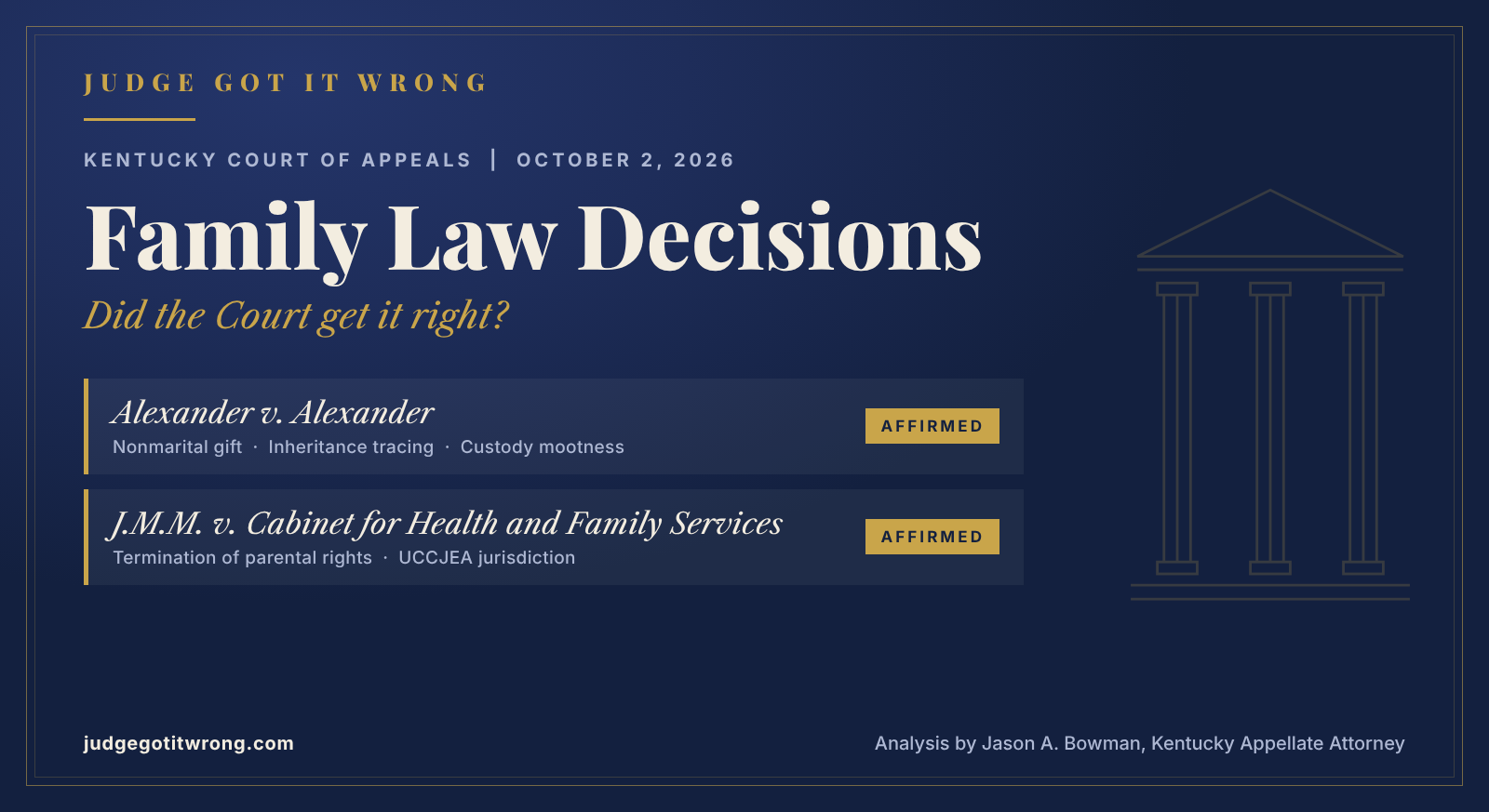
- On October 2, 2026, the Kentucky Court of Appeals released two (2) family law opinions. Both are designated Not To Be Published, and both affirm the family court.
- In Alexander v. Alexander, No. 2024-CA-1276-MR (Ky. App. Oct. 2, 2026), the Court held that a father’s $100,000 payment to finish the marital residence was a nonmarital gift to his son, that the wife traced her $70,000 inheritance under Allen v. Allen, and that the timesharing dispute became moot when the child turned eighteen (18) while the appeal was pending.
- In J.M.M. v. Cabinet for Health and Family Services, No. 2025-CA-1073-ME (Ky. App. Oct. 2, 2026), the Court affirmed the termination of a mother’s parental rights and rejected her UCCJEA jurisdiction and ineffective assistance of counsel arguments.
- The common thread is deference. Findings of fact are reviewed for clear error, so the record built in the family court is the case you will have on appeal.
Every Friday morning at 10:00 a.m., the Kentucky Court of Appeals releases its opinions. This week brought two (2) family law decisions worth a close read: a Carter County dissolution case on gifts, inheritances, and a custody issue that ran out of time, and a Fayette County termination of parental rights case built around jurisdiction and preservation. Here at Judge Got It Wrong, we ask the question in our name about every decision: did the Court get it right? Here is our breakdown.
What did the Kentucky Court of Appeals decide on October 2, 2026?
- Alexander v. Alexander, Nos. 2024-CA-1276-MR and 2024-CA-1315-MR, appeal and cross appeal from the Carter Circuit Court, Family Division. Affirmed. Opinion by Judge L. Jones; Judges Cetrulo and Combs concurring. Not To Be Published. Read the full Alexander opinion (PDF).
- J.M.M. v. Cabinet for Health and Family Services, Nos. 2025-CA-1073-ME and 2025-CA-1075-ME, appeals from the Fayette Family Court. Affirmed. Opinion by Judge McNeill; Chief Judge Thompson and Judge Moynahan concurring. Not To Be Published. Read the full J.M.M. opinion (PDF).
Unpublished opinions are not binding precedent, and RAP 41(A) disfavors citing them, but permits it when the opinion is final, was rendered after January 1, 2003, no published opinion adequately addresses the issue, and the citing party identifies it as nonbinding. Both of these opinions apply settled law in ways Kentucky families and practitioners will see again.
Alexander v. Alexander: gifts, inheritances, and a custody issue that aged out
Blake and Renee Alexander married in 2007 and had one (1) son, L.B.A., born in June 2008. Blake filed for dissolution in August 2023, the decree entered in November 2023, and the family court resolved the remaining issues in Findings of Fact, Judgment, and Order entered August 21, 2024. The court awarded joint custody, named Blake the primary residential parent, conditioned Renee’s timesharing on counseling, awarded Blake a $100,000 nonmarital interest in the marital residence, and restored Renee’s $70,000 inheritance to her as nonmarital property. Both parties appealed. You can read the Alexander opinion on the Kentucky Court of Justice website.
Why was the timesharing issue moot?
The timesharing appeal was moot because the child turned eighteen (18) on June 29, 2026, before the Court of Appeals ruled. The age of majority in Kentucky is eighteen (18) under KRS 2.015, and the timesharing statute, KRS 403.320, speaks of a “child.” The Court relied on Anderson v. Johnson, 350 S.W.3d 453, 456 (Ky. 2011), which recognizes that the family court’s continuing jurisdiction over timesharing runs until the child reaches majority or is emancipated. Once that happened, there was no live controversy left to decide.
This is the quiet lesson of Alexander. The judgment was entered when the child was nearly sixteen (16). The opinion came down more than two (2) years later. For families with teenagers, a custody appeal can outlast the custody question itself. That is why requests for interim relief, and a careful plan for child custody litigation from the start, matter so much.
When is money from a parent a nonmarital gift in a Kentucky divorce?
Property acquired during the marriage is presumed marital, but a spouse can overcome that presumption by proving the property was a gift to that spouse alone. KRS 403.190(2)(a) and (3). Under Hunter v. Hunter, 127 S.W.3d 656, 660 (Ky. App. 2003), the court considers the source of the money, the intent of the donor, and the status of the marriage at the time of the transfer. The donor’s intent is the principal factor, the party claiming the gift carries the burden, and the classification is a finding of fact reviewed for clear error. Id.
The facts were unusual. The parties took out a $100,000 construction loan in 2014 that Blake’s father cosigned. Most of the loan proceeds never went into the house, and the parties could not finish it or repay the loan. Blake’s father paid off the loan, oversaw construction, and financed completion of the home with money withdrawn from an investment account he had set aside for Blake’s inheritance. He testified that he intended the money as a gift to Blake alone, in lieu of that inheritance.
The family court valued the unencumbered residence at $365,000, awarded it to Blake, and awarded Renee one half of the equity after backing out the $100,000 gift, or $132,500. The Court of Appeals held that substantial evidence supported the finding and affirmed.
Can an inheritance deposited into a joint account remain nonmarital?
Yes, if the account balance never drops below the amount of the nonmarital deposit. Renee inherited $77,000 from her father and deposited $70,000 into the joint account. She proved the balance never fell below $70,000 until she withdrew that amount at separation. The Court applied the rule from Allen v. Allen, 584 S.W.2d 599, 600 (Ky. App. 1979):
“[T]he requirement of tracing should be fulfilled, at least as far as money is concerned, when it is shown that nonmarital funds were deposited and comingled with marital funds and that the balance of the account was never reduced below the amount of the nonmarital funds deposited.”
The Court noted that Chenault v. Chenault, 799 S.W.2d 575 (Ky. 1990), did not overrule Allen, citing Mattingly v. Fidanza, 411 S.W.3d 250, 257 (Ky. App. 2013), and it distinguished the June 2026 decision in Yelton v. Yelton, No. 2025-CA-0723-MR (Ky. App. June 18, 2026), because the account balance in Yelton did drop below the nonmarital deposit. Practitioners should read Alexander and Yelton together: the lowest intermediate balance is the whole ballgame.
The opinion also delivers a pointed aside. Neither party addressed the inheritance issue in more than two (2) paragraphs, and neither cited the record or any legal authority. RAP 32(A)(4) requires an argument with references to the record and citations to authority for each issue. A thin argument on appeal is an invitation for the Court to affirm without much discussion.
Did the Court get it right in Alexander?
On tracing and mootness, the answer is yes, and it is hard to argue otherwise. The gift ruling is the closer call. The Court acknowledged that the status of the marriage was not in question when the money was given, and money paid toward a home that both spouses live in is often found to be a gift to the marriage. The donor’s testimony carried the day, and because donor intent is the principal factor and the standard of review is clear error, the Court deferred to the family court’s finding. A different trial judge weighing the same testimony could have reached the opposite result, and that is precisely why the evidence presented at trial on intent, source, and documentation decides these cases. On appeal, deference usually wins. If you are dividing a home or an inheritance in a Kentucky divorce, the time to build that evidence is before trial. For a practical guide to protecting a gift or inheritance before trial, see Bowman Legal’s article, Is a Gift or Inheritance Marital Property in a Kentucky Divorce?
J.M.M. v. Cabinet: termination of parental rights affirmed
In J.M.M., a pro se mother appealed the Fayette Family Court’s judgment terminating her parental rights to two (2) children. The family had relocated to Kentucky from New Hampshire after child protective services there substantiated concerns of ongoing domestic violence. The Cabinet filed a dependency, neglect, and abuse petition in September 2021, obtained emergency custody, and the mother stipulated to neglect. A second petition followed after the mother’s oldest child disclosed years of serious abuse by the children’s father figure, and the mother stipulated to neglect again. The Cabinet petitioned to terminate parental rights on February 2, 2024, and the family court granted the petition. You can read the J.M.M. opinion here.
What standard does the Court of Appeals apply in a TPR appeal?
The Court reviews a termination judgment for clear error, asking whether it rests on clear and convincing evidence. Cabinet for Health and Family Services v. K.H., 423 S.W.3d 204, 211 (Ky. 2014). The Court gives “a great deal of deference” to the family court’s findings and will not disturb them “unless the record is devoid of substantial evidence to support them.” Cabinet for Health and Family Services v. T.N.H., 302 S.W.3d 658, 663 (Ky. 2010). As the Supreme Court of Kentucky has put it, appellate courts are “generally loath[] to reverse” termination decisions. D.G.R. v. Commonwealth, Cabinet for Health and Family Services, 364 S.W.3d 106, 113 (Ky. 2012).
Can a parent challenge UCCJEA jurisdiction for the first time in a TPR appeal?
The mother argued that neither Kentucky nor New Hampshire was the children’s home state under the UCCJEA when the Cabinet removed them. The Court observed that she never raised the argument in the dependency case and never appealed the disposition orders, and then held that jurisdiction existed anyway. Under KRS 403.828(1), a Kentucky court has temporary emergency jurisdiction when a child is present in the state and an emergency requires protection from mistreatment or abuse. Relying on Aldava v. Johnson, 686 S.W.3d 205, 213-14 (Ky. 2024), the Court explained that temporary emergency jurisdiction has no fixed expiration and continues until a court of a state with jurisdiction under another UCCJEA provision acts. With no competing custody determination, the emergency determination could become final under KRS 403.828(2), and the family court had jurisdiction over the termination action under KRS 403.822 or KRS 403.824.
Can ineffective assistance of counsel be raised in a TPR appeal?
Yes, but the burden is “onerous.” Z.T. v. M.T., 258 S.W.3d 31, 37 (Ky. App. 2008). The parent must show that counsel’s errors were so serious that the record reveals a denial of a fair and meaningful opportunity to be heard. Id. at 36. The mother’s allegations were conclusory, so the claim failed.
How did the Court apply KRS 625.090?
Termination requires clear and convincing proof that (1) the child is or has been adjudged abused or neglected, (2) termination is in the child’s best interest under KRS 625.090(3), and (3) at least one (1) ground of parental unfitness under KRS 625.090(2) exists. The mother’s two (2) neglect stipulations satisfied the first prong. On best interest, the family court found that despite therapy, the mother continued to minimize the abuse and to deflect responsibility; the court expressed sympathy for her as a domestic violence victim but found that status “does not absolve her of responsibility” for her role in the children’s trauma. On the third prong, the children had been in foster care for twenty eight (28) months before the petition, satisfying the fifteen (15) of forty eight (48) months ground in KRS 625.090(2)(j). Because only one (1) ground is required, T.N.H., 302 S.W.3d at 663, the Court did not reach the others.
Did the Court get it right in J.M.M.?
Under the governing standard, the result is difficult to second guess. The case does surface a real tension in Kentucky dependency practice: the parent who is herself a survivor of domestic violence. The family court confronted that tension directly in its findings rather than ignoring it, and that kind of careful, specific fact finding is exactly what makes a termination judgment hold up on appeal. The more practical lesson is about preservation. A jurisdictional challenge belongs in the dependency case, and disposition orders that a parent believes are wrong need to be challenged when they are entered, not years later in the termination appeal. Parents facing a dependency, neglect, and abuse case should involve experienced counsel at the earliest stage.
What do these decisions teach about Kentucky family law appeals?
- The trial record decides the appeal. Both decisions turn on the clear error standard. Evidence of donor intent, account statements that show the lowest balance, and specific best interest findings are built in the family court, not in the brief.
- Time can moot your issue. A custody or timesharing appeal involving an older child can expire before the opinion issues. Consider interim relief early.
- Preserve everything. Arguments not raised below, or orders not appealed when entered, are difficult or impossible to revive later.
- Brief every issue properly. Two (2) paragraphs without record citations or authority is not an argument the Court can act on.
- Know the extraordinary remedies and their limits. When an order cannot wait for a final appeal, a writ of mandamus or prohibition is sometimes available, but rarely.
Frequently Asked Questions
Is a gift from my parent during the marriage marital or nonmarital property in Kentucky?
It is presumed marital under KRS 403.190(3), but it is nonmarital if the spouse claiming it proves it was a gift to that spouse alone. Courts weigh the source of the money, the donor’s intent, and the status of the marriage, with donor intent as the principal factor, under Hunter v. Hunter, 127 S.W.3d 656 (Ky. App. 2003).
Does an inheritance become marital if I deposit it into a joint account?
Not necessarily. Under Allen v. Allen, 584 S.W.2d 599 (Ky. App. 1979), commingled nonmarital money is traced if the account balance never fell below the amount of the nonmarital deposit. If the balance dropped below that amount, as in Yelton v. Yelton (Ky. App. 2026), the tracing analysis becomes much harder.
What happens to a custody appeal if my child turns 18 while it is pending?
The custody and timesharing issues generally become moot, because the family court’s authority over timesharing ends when the child reaches the age of majority. The Court of Appeals applied that rule in Alexander v. Alexander on October 2, 2026.
What standard does the Kentucky Court of Appeals use in a termination of parental rights appeal?
The Court asks whether the family court’s findings are clearly erroneous, meaning whether the termination rests on clear and convincing evidence. The Court gives substantial deference to the family court’s findings.
Can I cite an unpublished Kentucky Court of Appeals opinion?
Yes, within limits. Under RAP 41(A), citation is disfavored, but an unpublished opinion may be cited if it is final, was rendered after January 1, 2003, no published opinion adequately addresses the issue, and the citing party identifies it as nonbinding authority.
Talk with a Kentucky family law appellate attorney
If a family court ruling has gone against you, or you are facing an appeal, the time to talk with an appellate attorney is before the deadlines run. Bowman Legal handles family law appeals, writs, and emergency motions across Kentucky. Please call our office at (502) 861-7414 or visit our appellate practice page so we can review the order and start building your strategy.
This article is general information about Kentucky law and appellate procedure. It is not legal advice about any specific case, and reading it does not create an attorney client relationship.